North Atlantic

NAT HLA · EDTO · A350

Crossing the pond in the A350: what the NAT HLA is, how to set up the FMS for your EDTO alternates, and what changes at the entry point.

  • 11 facts
  • Checked 5 Nov 2026

The airspace

The North Atlantic High Level Airspace covers FL285 to FL420 inclusive across the Reykjavik, Shanwick, Gander, Santa Maria, Bodø and New York East oceanic areas. Most crossings are flown inside it, and in the real world it takes a formal approval.

Source: NAT Doc 007 V.2026-1

Setting up the FMS

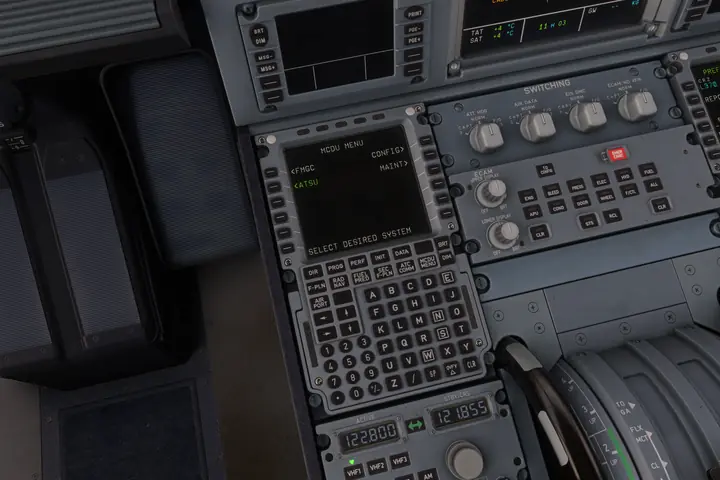
Create a custom waypoint from the coordinates of your NAT entry and NAT exit point. Everything that follows builds on those two.

FMS → F-PLN → DATA → WAYPOINT

EDTO stands for Extended Diversion Time Operations, the ICAO term for what most pilots still call ETOPS. Add your first two EDTO airports to FIX3 and FIX4 with the preferred runway, the inbound radial and a 25 NM range ring for the MSA.

FMS → F-PLN → F-PLN INFO → FIX INFO

Enter the same two EDTO airports, with their preferred runways, on the Equi-Time Point page. The ETP is where both alternates are the same flying time away.

FMS → F-PLN → F-PLN INFO → EQUI-TIME POINT

For REF1 and REF2, pick one waypoint on your route between the ETP and the EDTO alternate. Take its wind from your flight plan, at your current engine-out maximum flight level from the PERF page.

FMS → PERF

At the entry point and beyond

Take the ETA for your entry point and count back. On VATSIM, Shanwick and Gander no longer need an oceanic clearance before entry, but you still send an RCL through natTrak 30–90 minutes before the entry point. Entering at PIKIL at 1455z means an RCL by 1425z at the latest.

FMS → POSITION → TIME

An RCL is not a clearance. It gives your entry point, time, level and Mach. Real-world windows differ: Gander 90–60 minutes, Shanwick 90–30 minutes before entry.

Source: VATSIM (Dec 2024) · NAT Doc 007 V.2026-1, 6.3.24

On VATSIM, make voice contact with Shanwick or Gander Radio at the entry point for a SELCAL check and your onward frequency. From there on, no change of level, speed or route without an ATC clearance.

Source: VATSIM (Dec 2024)

Keep your last assigned code for 10 minutes after passing the entry point, then set 2000 unless ATC says otherwise. The exceptions are Reykjavik, whose code you keep throughout its area, and New York within Bermuda radar airspace.

Source: NAT Doc 007 V.2026-1, 8.2.2

The Strategic Lateral Offset Procedure (SLOP) spreads traffic off the centreline and is standard across the NAT. Fly the centreline or up to 2 NM right, never left, and you do not have to tell ATC. Be back on the centreline before the exit point. Our A350 habit: 2 NM right from entry to exit, 1 NM right with traffic ahead.

FMS → F-PLN → WAYPOINT → OFFSET

Source: NAT Doc 007 V.2026-1, 6.3.48 and 6.5.3

Checked against: ICAO NAT Doc 007 V.2026-1, VATSIM and our own A350 flights in the simulator, 5 Nov 2026. For flight simulation only, never for real-world navigation. Procedures change, so your current charts and ATC always win.

More topics