Frankfurt

FRA / EDDF

The busiest airport on VATSIM and our home base. What to know before you push, taxi or land here, from break-away areas to the visual swing onto 25C.

  • 18 facts
  • Checked 5 Nov 2026

On the ground

Busy parts of the apron work with numbered break-away areas, also called pushback areas. They are on the ground charts, and good sceneries show the marking where your nose gear has to stop. Some areas need a push and pull. If you cannot do that, tell ATC before you accept the clearance.

ATCLufthansa 123, pushback approved, area 5.
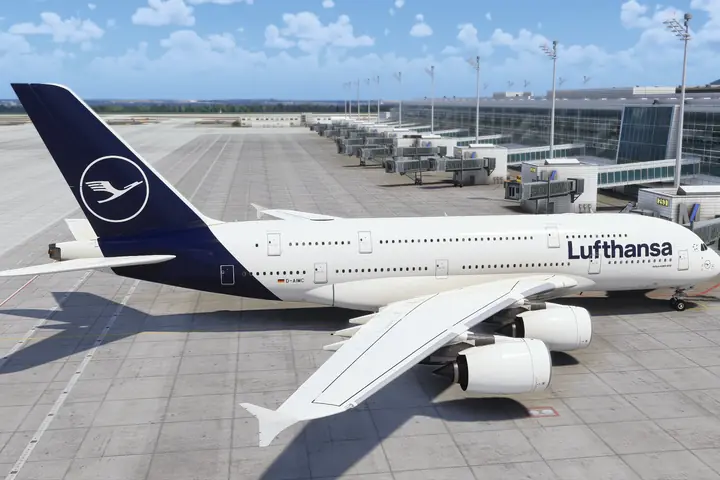
Start-up approval is not a pushback clearance, and it does not mean engines on at the stand. In Frankfurt you start during pushback. The only exception is a taxi-out stand, where no push is needed.

The coloured taxi lines let two aircraft pass on one taxiway. They are for aircraft up to code C, so an A321 or B739 at most, with a wingspan up to 36 m. They are not lit, but on VATSIM they may still be used at night.

Taxiways T, U and Y carry stopbars that protect the extended centrelines of 25C/07C and 25L/07R. Treat them like a runway holding point and never cross without explicit clearance. Once cleared, keep rolling until your whole aircraft is past the next stopbar.

Traffic landing on 25L/07R and parking in the north has to cross the centre runway or its extended centreline. Hold at the CAT II/III holding point when told to. A Runway Incursion Alerting System guards M6, M8 and M30: roll even slightly over an active stop bar and bright red lights flash in front of you while the Tower is alerted. If that happens, stop and call Tower.

25 operations
T4 · Y10 · M10 · M30
07 operations
T4 · M6 · M8

Brief the expected crossing during your approach briefing, so you do not have to stop and block the runway exit.

Taxiway L always runs towards the holding point of the centre runway, so its direction flips with the runway in use. Taxiway N runs the other way. During 07 operations, N west of N11 also runs westbound for runway 18 departures, via L, N14 and N.

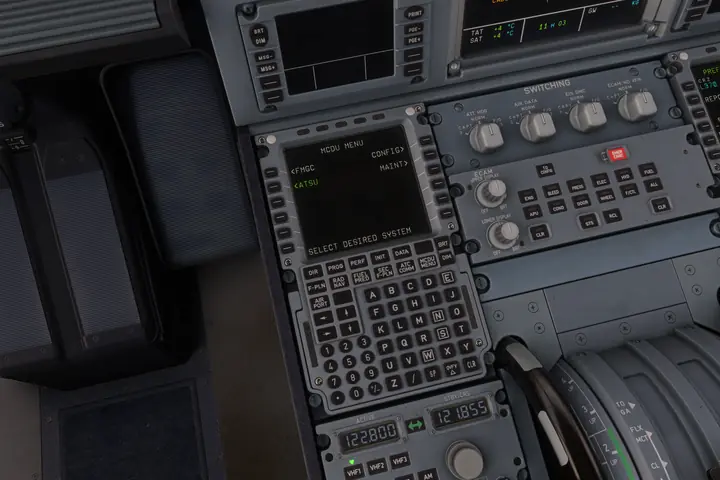
Frankfurt's apron is split into three sectors. On VATSIM they log on as EDDF_W_GND, EDDF_C_GND and EDDF_E_GND, while the charts list the same frequencies under Apron. Every frequency change needs an explicit handoff, and some frequencies may not show in your pilot client, so listen closely.

EDDF_W_GND
121.755
EDDF_C_GND
121.855
EDDF_E_GND
121.955

Lufthansa operates from Terminal 1, piers A, B and Z. Discover uses Terminal 1, pier C. VATSIM Germany asks everyone to use all stands, not only A and B, and to stay off V151, V152 and V153: many sceneries still show the old N8 taxiway there, so you would block it.

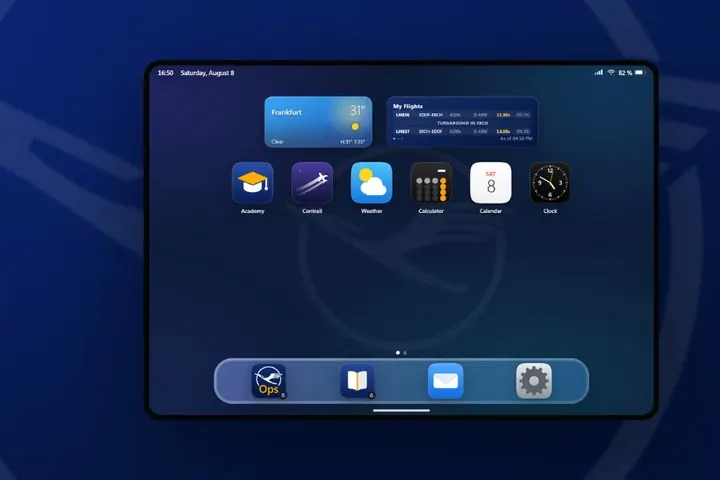
Not sure? Ask for your planned gate on arrival. Your Crew Pad shows a stand as soon as a live source has one.

Departure

Unlike Munich, Frankfurt has no single number. Depending on the SID it is 4000 ft, 5000 ft or FL070. Check the chart of the SID you were cleared for, not the one you flew last time.

The chart of your cleared SID names the one you need. Stay on Tower until you are handed over: every frequency change here needs an explicit handoff.

Departure North
120.155
Departure South
136.130

Plan it before you call. Four-engine heavies departing 25, including those parked in the east, and every A380 are de-iced on the stand. For 07C and 18 expect pads DP1 and DP2, and two-engine heavies for 25C go to DP4.

RWY 07C / 18
DP1 · DP2
RWY 25C, twin heavy
DP4
RWY 25, four-engine heavy
On stand
A380
Always on stand

Arrival and landing

Wherever you come from, the designator shows which corner of the field the STAR finishes in. A and B end east of the airport and belong to 25 operations, C and D end west and belong to 07 operations. Use it to prepare your arrival runway before one is assigned.

A
North-east · 25 operations
B
South-east · 25 operations
C
South-west · 07 operations
D
North-west · 07 operations

Aim for these levels so you do not end up on an unnecessarily long final. They are for planning only: every level change still needs a clearance. There is no 250-knot limit below FL100, because the Frankfurt TMA is class C.

ADNIS
FL100
KERAX
FL110
OSPUL
FL100
SPESA
FL110
ROLIS
FL150
RAMOB
FL110

Plan your speed too: 260–300 KIAS in the descent, 220 KIAS on base, 180–200 KIAS on the turn to final. ATC instructions always win.

ILS Y on 25R/07L has a 3.2° glide path instead of the usual 3°. ILS Z with 3° is used in low visibility or with a tailwind. Fly the one ATC assigns, and tell Approach on first contact if you cannot accept 3.2°.

The north-west runway is closed to the largest types. After landing, vacate and continue on taxiway P. P1 is mainly for cargo aircraft, so do not use it unless you are told to.

Not available for
B747 · A380 · MD-11 · L-1011 · An-124 · An-225

On 25 operations, arrivals for 25L may be asked to continue visually to 25C below 2,500 ft. It shortens your taxi and helps the flow. Accept only with the runway in sight, and do not mistake taxiway M for 25C. On 07 operations it is normally not available.

YouRunway 25C in sight.

In the A320: set runway heading and the go-around altitude of 5000 ft, then flight directors off, LS off and the G/S mode pushbutton off on the overhead panel.

Checked against: Current airport charts and the VATSIM Germany Knowledgebase, 5 Nov 2026. For flight simulation only, never for real-world navigation. Procedures change, so your current charts and ATC always win.

More topics